
中吉通
中吉综合便民服务平台
中亚云桥科技有限公司
Central Asia Cloud Bridge LLC
由程远嘉设计推出
Designed by Cheng Yuanjia
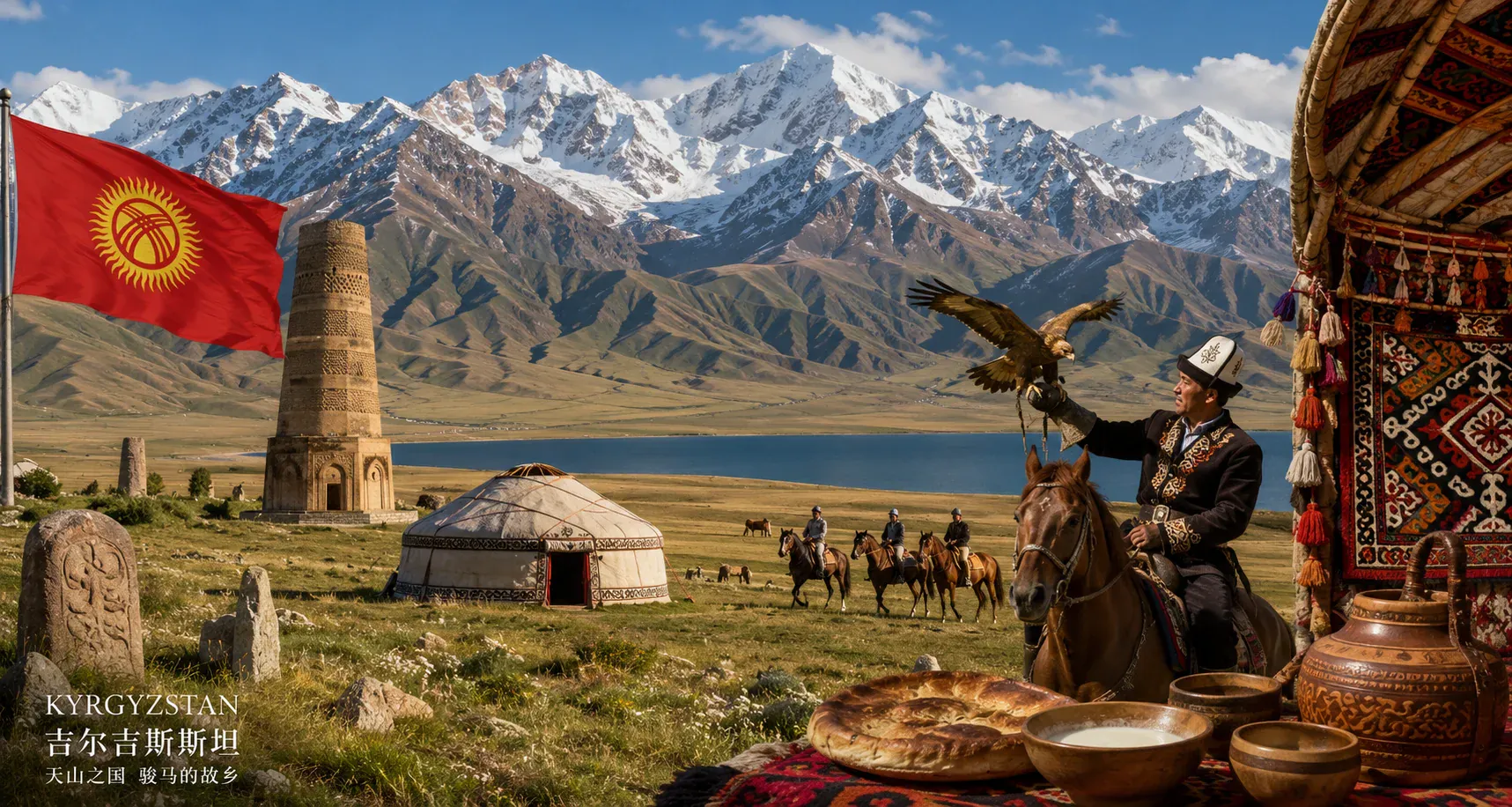
Ancient Central Asian land · a crossroads of history
When you first arrive in Kyrgyzstan, three things matter most. First, documents: visas, registration, residence and work permits all have deadlines, and overstaying can mean fines or deportation — keep track of your dates. Second, language: Russian is spoken everywhere in the cities, and a few phrases for asking the way, bargaining and taking a taxi go a long way. Third, money and phone: change some som and get a local SIM card. The mountains are beautiful, prices are moderate and people are mostly warm and friendly, but things move slowly and rules change often — check National Policies for the latest rules, or ask fellow Chinese in the community.
| Capital | Bishkek |
|---|---|
| Area | About 200,000 km² |
| Population | About 7.4 million (early 2026) |
| Languages | Kyrgyz (state), Russian (official) |
| Currency | Som (KGS) |
| Time zone | UTC+6, 2 hours behind Beijing |
| Calling code | +996 |
| Highest peak | Jengish Chokusu (Victory Peak), 7,439 m |
| Independence Day | 31 August (1991) |
| Traffic | Drives on the right |
| Power | 220 V, European round two-pin plugs (types C / F) |
| Neighbours | China, Kazakhstan, Uzbekistan, Tajikistan |
The Kyrgyz Republic, commonly called Kyrgyzstan, is a landlocked country in Central Asia with its capital in Bishkek. It covers about 200,000 km², over 90% of it mountains, and has a population of about 7.4 million (early 2026), nearly half of whom live in Bishkek, Osh and Chuy Region.
It is a multi-ethnic country with more than 80 ethnic groups. Ethnic composition in the 2022 census:
Language & religion: Kyrgyz is the state language and Russian is an official language widely used in cities, business and government; with Russian you can get around the whole country. Most people are (Sunni) Muslims, while Russians and some other groups are mostly Orthodox Christians; the constitution defines the state as secular. Kyrgyz culture is rooted in Turkic nomadic traditions with Mongol, Persian and Russian influences.
Kyrgyzstan has a typical temperate arid and semi-arid climate, with large vertical temperature changes. July and August are hot, around 30°C; from December to February, winter temperatures can drop to -30°C.
Terrain: Over 90% of the country is mountainous, with an average elevation of about 2,750 m; roughly half lies between 1,000 and 3,000 m and about a third between 3,000 and 4,000 m. The lowest point, in the Kara-Darya valley in the southwest, is only a little over 100 m. In the northeast stretches the majestic western Tian Shan, while the southwest is home to the Pamir-Alay range. Only small lowlands lie in the southwest and north.
Rivers & administrative divisions: The Naryn River, 540 km long, crosses the whole country; the Chuy River is 220 km long. The famous ice-free alpine lake Issyk-Kul is a famous tourist destination. The country is divided into two cities and seven regions: Bishkek (the capital and largest city), Osh (a city of national significance), and Batken, Chuy, Jalal-Abad, Naryn, Osh, Talas and Issyk-Kul regions. Officials of these divisions are appointed by the central government, though some remote village governments are run by elected heads and councils.
Issyk-Kul covers about 6,200 km², is about 670 m deep at its deepest and lies about 1,600 m above sea level — one of the world's largest alpine lakes, and it does not freeze in winter. Song-Kul, another famous lake, lies at about 3,000 m and serves as summer pasture for herders.
As an ancient Central Asian land, Kyrgyz history goes back 2,000 years. Surrounded by mountains and relatively isolated, many nomadic traditions have been well preserved. Yet its location at the center of several countries made it a meeting point for many cultural powers.
Origins in Chinese records: Turkic Qırğız, recorded in Chinese histories as "Xiajiasi". In the Han dynasties they were called "Jiankun"; from the Wei, Jin and Northern and Southern dynasties to the Sui, "Jiegu" or "Qigu"; and in the Tang, generally "Xiajiasi" by transliteration. In 640, Emperor Taizong of Tang pacified Gaochang, established Xizhou, and set up in the Western Regions the Anxi Protectorate; in 658 its seat moved to Qiuci (Kucha). The Tang also built the town of Suyab near today's Tokmok (the Ak-Beshim ruins). Scholars disagree about where the poet Li Bai was born; Guo Moruo and others believe it was Suyab.
Successive eras: In ancient times the region lay within the sphere of steppe powers such as the Xiongnu, Xianbei, Rouran and Turks. The Tang-era Kyrgyz (Xiajiasi) rose on the upper Yenisei and defeated the Uyghur Khaganate in 840, dominating the Mongolian steppe for a time. The Kyrgyz later migrated south-west and by around the 15th–16th centuries had settled in the Tian Shan, coming under the influence of the Dzungar and Kokand khanates; Qing records called the Tian Shan Kyrgyz "Bulut". In the 1860s–1870s the region was gradually incorporated into the Russian Empire.
Soviet period: Joined the Soviet Union in 1922; the Kara-Kirghiz Autonomous Oblast was established in 1924; upgraded to the Kirghiz Soviet Socialist Republic in 1936; became independent from the USSR in 1991 as a modern nation-state.
The country is a unitary presidential republic. Since independence in 1991, it has tried to democratize, but political and social development has been full of twists:
The loss of the single Soviet market hit Kyrgyzstan's economy very hard. After independence the country privatized and in 1998 became the first CIS country to join the World Trade Organization. Its main sectors:
Trade outlook:Kyrgyzstan is relatively open to foreign investment and is a member of the WTO, the CIS and the Eurasian Economic Union. Many labour migrants work in Russia and elsewhere, and their remittances make up a large share of the economy. Under the Belt and Road Initiative, the international railway (China–Kyrgyzstan–Uzbekistan railway): the intergovernmental agreement was signed on 6 June 2024 and construction was launched in Kyrgyzstan on 27 December 2024. The line runs from Kashgar in China via the Torugart pass, Makmal and Jalal-Abad to Andijan in Uzbekistan — about 530 km in total, around 300 km of it in Kyrgyzstan — with completion targeted for 2030. China, Russia, Kazakhstan, Uzbekistan and Türkiye are among Kyrgyzstan's key trading partners.
| 1 January | New Year |
|---|---|
| 7 January | Orthodox Christmas |
| 23 February | Defender of the Fatherland Day |
| 8 March | International Women's Day |
| 21 March | Nowruz |
| 7 April | Day of the People's April Revolution |
| 1 May | Labour Day |
| 5 May | Constitution Day |
| 9 May | Victory Day |
| 31 August | Independence Day |
| 7–8 November | Days of History and Commemoration of Ancestors |
| Islamic calendar | Orozo Ait (Eid al-Fitr) and Kurman Ait (Eid al-Adha), dates change each year |
When a holiday falls on a weekend, days off are usually moved; follow the schedule the government publishes each year.
Tap to hear them. Russian works everywhere in the cities; a few words of Kyrgyz will win you extra smiles.
| Hello | Здравствуйте! | Саламатсызбы! |
|---|---|---|
| Thank you | Спасибо! | Рахмат! |
| Excuse me / Sorry | Извините. | Кечиресиз. |
| Goodbye | До свидания! | Көрүшкөнчө! |
| Where is the stop? | Где остановка? | Аялдама кайда? |
| Please stop here | Остановите здесь, пожалуйста. | Ушул жерге токтотуңуз. |
| How much is it? | Сколько стоит? | Канча турат? |
| That's expensive! Can you lower the price? | Дорого! Сделайте скидку, пожалуйста. | Кымбат экен! Арзандатып бериңизчи. |
| The bill, please | Счёт, пожалуйста. | Эсепти алып келиңизчи. |
| I don't understand | Я не понимаю. | Түшүнбөйм. |
| Do you speak Chinese? | Вы говорите по-китайски? | Сиз кытайча сүйлөйсүзбү? |
| Help! | Помогите! | Жардам бериңиз! |
China and Kyrgyzstan established diplomatic relations on 5 January 1992. They share a border of more than 1,000 km with Xinjiang; the main road crossings are Torugart and Irkeshtam. In 2018 relations were upgraded to a comprehensive strategic partnership. China is one of Kyrgyzstan's largest trading partners, and Chinese companies invest in mining, roads, energy, telecoms and agriculture. Bishkek has several Confucius Institutes and Chinese schools, and more and more young Kyrgyz are learning Chinese.
Visa, residence and registration rules change — see the National Policies section. To learn Russian or Kyrgyz, visit the Language school.
* Compiled from the National Statistical Committee of Kyrgyzstan, Wikipedia and public news reports. Figures and rules change; check the latest official information before dealing with authorities.
More about life in Kyrgyzstan in the KRGZ app · Get the app